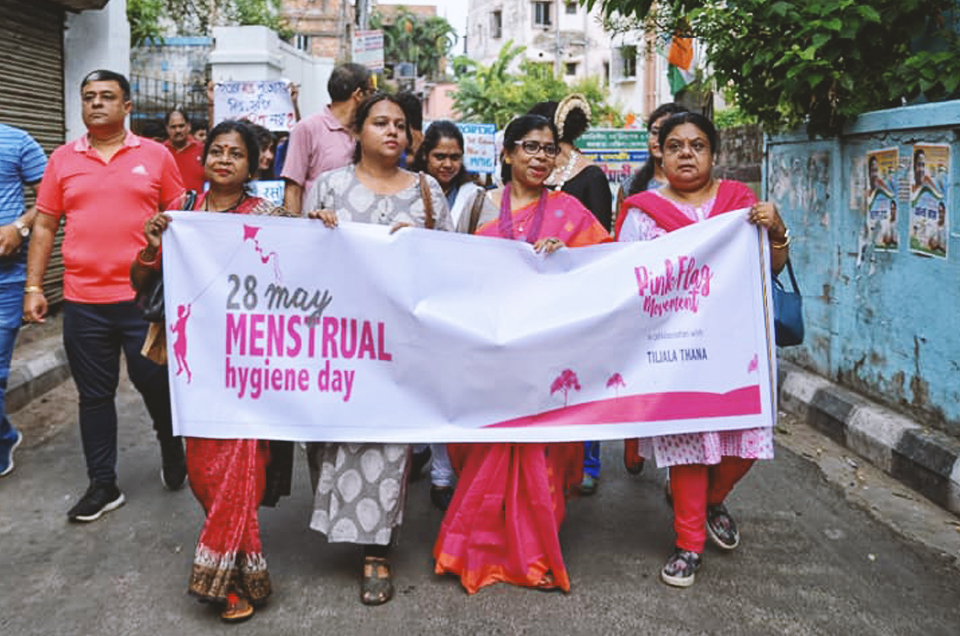
Menstruation – A Social STIGMA

PinkFlag starts its maiden journey
September 11, 2020
3 out of 10 girls are unaware about menstruation at the time of her first period.
During the menstruation period, they are forced into seclusion, their mobility is reduced & they have food restrictions too. Unfortunately, the silence and stigma surrounding menstruation makes solutions for menstrual hygiene management a low priority & often ignored by professionals.
Menstruation is the prestigious inaugural ceremony of womanhood is still shrouded by myths & taboos. It has many negative cultural attitudes like, menstruating women and girls are ‘contaminated’, ‘dirty’ and ‘impure’.
Menstruation taboos can keep women and girls from touching water or cooking, attending religious ceremonies, or engaging in community activities. These taboos reinforce gender-based discrimination, perpetuating the idea the menstruating women and girls are unclean. And this culture is not limited to the state of West Bengal or within the geographical boundaries of India. It is a global issue and every second country has this problem. “Women and girls are using clean menstrual hygiene management material to absorb or collect blood that can be changed in privacy as and when necessary for the duration of the menstrual period, using soap and water for washing the body as required and having access to facilities to dispose of used menstrual management materials”.
– WHO and UNICEF (2014)
The way forward
Out of some scattered events, here and there, across the country, we need to shed the stereotype factor. The stigma around these terms and concepts weren’t just limited to silence and the biology classes of our schools. Even a lot of women have no knowledge about maintaining period hygiene.
The first step is to break this silence. The approach should be holistic to give women and girls the confidence and space to voice their need for improved menstrual hygiene management.
One of the critical aspects of this endeavor is availability of safe and hygienic materials that can be used to capture and absorb menstrual blood. This includes clean cloths and sanitary pads.
Here is a 7 step process that must be followed to curb the social menace of menstruation;
- Advocacy
- Increased Access
- Increased Availability
- Safe Disposal
- Research
- Training
- Wide Spread Awareness
“PinkFlag Movement” is a consolidated approach towards Menstrual Hygiene Management (MHM).It is aimed at targeting girls at menarche in the semi- urban and rural areas in order to improve their menarche and make it cleaner, sanitary and more understandable to them.
Menstruation is still a social stigma, a taboo. It’s time to educate the young girls and boys about the same. We need to take this initiative to the schools, spread the awareness directly from the grass root level so that the cause reaches to across all the sections of the society. Until, we discuss about this issue openly on public forums and active participation is guaranteed, we will not be able to free our country from the misinformation prevailing about menstruation. This active participation should come from the ones whom the general public look up to – the religious gurus to be more precise.
Spreading of awareness among the males in the family regarding MHM and in turn awareness of the society regarding long term effects of the MHM.